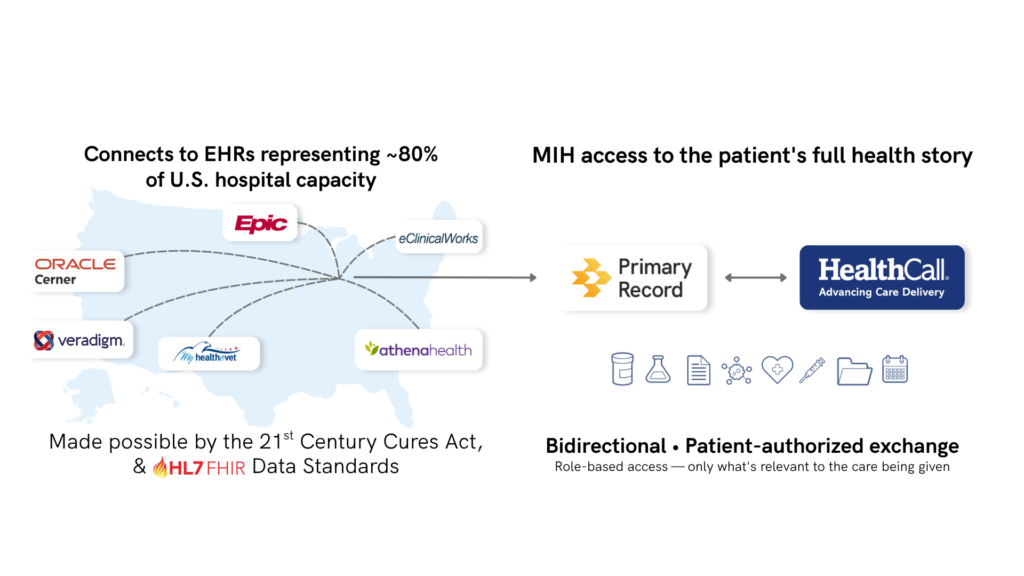


When I began my internship with Primary Record, I expected to spend my summer learning about electronic health records, health information exchange, and digital health technology. As a public health student preparing for a career in healthcare, I knew technology was becoming an increasingly important part of patient care. Still, I had little understanding of what happened behind the scenes to make health information accessible. Early in my internship, I learned about the 21st Century Cures Act, health information interoperability, patient ownership of medical records, and the challenges many patients face when trying to access their own health information. As I learned more about Primary Record’s mission, I quickly realized these issues were especially important for immigrant communities like my own.
Why Health Literacy Is Different for Non-Native English Speakers
Being Eritrean American, I have seen how language barriers, cultural differences, and limited health literacy can make navigating the healthcare system difficult. Family members often depend on one another to explain medical information, translate appointments, or help manage health records. I wanted to explore whether artificial intelligence could help bridge some of these gaps by making health information easier to understand in a person’s preferred language.
From Testing One App to Asking a Bigger Question About AI and Language
My original project focused on evaluating Primary Record’s AI Chat Assistant in Tigrinya and Amharic to determine whether it could improve health literacy within the Eritrean and Ethiopian communities. The goal was to connect participants’ medical records to Primary Record and evaluate whether AI conversations increased their understanding and confidence. On paper, we already knew a language like Tigrinya was “serviceable” from Primary Record’s own language support documentation, which classifies it as able to handle simple questions, but with real limitations in grammar, depth, and complex reasoning.
What we didn’t know, and only learned by testing with real participants asking real questions about their real health records, was exactly where it broke down: a missing instruction telling the model to respond in the user’s own language, and a deeper mismatch between English-language medical records and non-English questions, since the Chat Assistant searches records by converting a question into a numerical “embedding”, a step that loses accuracy fast in less common languages like Tigrinya. I learned that dealing with language and embedding models is deceptively challenging and can be impacted by the AI model being used.
Rather than ending the project, Jean Ross, RN, and I decided to adapt the study. We shifted from evaluating just Primary Record to exploring a broader question: Can artificial intelligence help non-English speakers better understand their health information and increase their confidence when interacting with healthcare providers? To answer this question, we used Claude AI connected to participants’ personal health records through HealthEx, which allowed us to use Sonnet 5 for free. This allowed participants to ask questions about their own medical information in Tigrinya or Amharic while still exploring the role AI could play in improving health literacy.
Meet the Participants: Real Caregiving and Communication Challenges
Three participants from the Eritrean and Ethiopian community took part in this pilot project. They represented different ages (from 28 to 66), health literacy levels, and experiences living in the United States. Some managed their own healthcare independently, while others relied on family members or interpreters, a common caregiving reality for non-English-speaking households.
Participants first completed a short pre-test that explored their confidence in completing medical forms, how they usually found answers to health questions, and their comfort communicating with healthcare providers. After completing the pre-test, participants connected their patient portals through HealthEx and used Claude AI to ask questions about their personal medical records using prompts translated into Tigrinya or Amharic. They were encouraged to ask questions about their health history, laboratory results, and information they wanted to better understand. Following the AI experience, participants completed a post-test and answered several open-ended questions about their confidence, understanding, and overall experience using the tool.
Before AI: Low Confidence and Relying on Family to “Understand My Doctor”
The pre-test responses revealed several common themes related to health literacy and confidence:
- When asked how confident they felt filling out medical forms independently, two participants rated themselves a 2 out of 5, while one rated herself a 3 out of 5. This showed that all participants experienced some difficulty managing healthcare paperwork on their own.
- When asked what they normally do if they have questions about their health or a recent doctor’s visit, all three said they usually turn to family members, friends, or someone they know who works in healthcare. Some admitted that if they couldn’t find someone to ask, they sometimes ignored their questions altogether.
- When asked how comfortable they felt asking their doctor questions, two rated themselves 3 out of 5, explaining that they often felt overwhelmed by the amount of information shared during appointments. The third rated herself 4 out of 5, saying she felt more confident because she had access to a medical interpreter.
These findings suggest that language support, trusted sources of information, and improved access to understandable health information play an important role in helping patients participate confidently in their own care.
After Using AI: Confidence Nearly Doubled Across the Board
After using Claude AI with their personal health records, all three participants reported noticeable improvements in confidence and understanding:
- Every participant rated their confidence in completing medical forms as 5 out of 5 after the intervention.
- They explained that AI helped them better understand their medical history, health conditions, and laboratory results in their preferred language.
- Many were surprised by how accurate, clear, and grammatically correct the responses were in Tigrinya or Amharic.
- All participants said they would use AI to answer future health questions because it provided clear explanations without making them feel rushed or embarrassed.
Participants also reported feeling more confident communicating with healthcare providers. Two increased their confidence rating to 4 out of 5, while one rated herself 5 out of 5. They explained that AI helped them understand medical terms before or after appointments and prepare better questions for their doctors. Several suggested that an AI tool capable of recording, translating, and summarizing doctor visits would be especially valuable, allowing them to review appointments later and keep learning after leaving the clinic.
In Their Own Words: What Participants Said About Using AI for Health Understanding
The open-ended responses reinforced the survey findings. All participants said they felt more confident working with their healthcare providers after using AI because they better understood their health information and felt more prepared for future appointments. Two said the technology was easy to use once the initial setup was complete and believed they could use it independently after basic instruction. One participant shared that the technology was more challenging at first and that she would initially need help from family members, but still believed she would become comfortable over time.
All three said they would continue using AI to help manage their health because they appreciated the clear explanations, accuracy, and ability to receive information in their preferred language. Once participants completed the initial account setup and connected their health records, they were able to navigate the AI successfully and quickly find the information they wanted.
Limitations of This Study
This project has several limitations worth noting:
- The study included only three participants, making it difficult to generalize findings to the broader Eritrean and Ethiopian community or other immigrant populations.
- Participants were family members and individuals within my own community, which may have influenced their willingness to participate and their comfort level during interviews.
- Because the original project had to be modified after discovering language limitations within Primary Record’s AI assistant, the intervention was conducted using Claude AI connected through HealthEx instead. Future studies should evaluate multilingual AI directly within patient-centered health platforms as those language capabilities continue to improve.
What This Means for the Future of AI, Caregiving, and Health Literacy
Although this was a small pilot project, the findings demonstrate real potential for AI to become an important tool for improving health literacy among immigrant communities. Participants became more confident in understanding their own health information, preparing for medical appointments, and communicating with healthcare providers. Rather than replacing doctors or interpreters, AI served as an educational tool that allowed patients to revisit information, ask additional questions, and learn at their own pace.
For healthcare organizations, policymakers, and digital health companies, these findings highlight an opportunity to improve patient engagement by making health information easier to understand in multiple languages. As healthcare continues to become more digital, ensuring that patients can understand their own medical information will be just as important as giving them access to it.
A Personal Moment That Changed How My Family Sees AI
When I first began this internship, I thought my project would mainly be about testing a new health technology. As I spent more time talking with members of my community, I realized the project was never really about the technology itself. It was about helping people feel more confident understanding their own health.
One of the most meaningful moments happened after I showed my mom how AI could explain health information in Tigrinya. Like many people, she had mostly heard about AI through social media or entertainment. After seeing it summarize medical information in a language she understood, her perspective changed. She told me she had never thought AI could be used in a way that could genuinely help people learn about their health. Instead of seeing it as something complicated or unnecessary, she saw it as a tool that could help families like ours better understand medical information that often feels confusing or overwhelming.
That moment reminded me why this project mattered. Throughout my interviews, participants repeatedly shared that they often leave doctor’s appointments with unanswered questions or rely on family members to explain medical information later. Many hesitate to ask questions because they feel rushed, intimidated, or worry about asking “too many” questions. Having an AI assistant available in their preferred language allowed them to learn on their own time, revisit information as often as they needed, and build confidence before their next appointment.
Key Takeaway: Health Information Is Only Empowering When You Can Understand It
As a future public health professional, this experience reinforced that improving health outcomes is not only about creating new technologies. It is about making those technologies understandable, accessible, and culturally relevant. When people can understand their own health information without feeling embarrassed or rushed, they become more active participants in their care.
Although this project involved only a small group of participants, it showed the potential for AI to improve health literacy in underserved communities. I hope future work continues to explore how multilingual AI tools can complement interpreters, support healthcare providers, and help reduce barriers to understanding health information. Health information is only truly empowering when people can understand it. Giving patients the opportunity to learn about their health in their own language, at their own pace, may be one of the simplest ways we can build confidence, trust, and better healthcare for everyone.
References
- Muvuka B, Combs RM, Ayangeakaa SD, Ali NM, Wendel ML, Jackson T. Health Literacy in African-American Communities: Barriers and Strategies. Health Lit Res Pract. 2020 Jul 16;4(3):e138-e143. doi: 10.3928/24748307-20200617-01. PMID: 32674161; PMCID: PMC7365659.
- McKenna VB, Sixsmith J, Barry MM. The relevance of context in understanding health literacy skills: Findings from a qualitative study. Health Expect. 2017 Oct;20(5):1049-1060. doi: 10.1111/hex.12547. Epub 2017 Apr 12. PMID: 28402013; PMCID: PMC5600250.
- Christopher, A., Chen, Y.-J., Hovey, P., & Muhumure, A. (2025). Bridging African immigrant health literacy gaps. Health Equity, 9(1), 520–528. https://doi.org/10.1177/24731242251378089
- Lyles CR, Nelson EC, Frampton S, Dykes PC, Cemballi AG, Sarkar U. Using Electronic Health Record Portals to Improve Patient Engagement: Research Priorities and Best Practices. Ann Intern Med. 2020 Jun 2;172(11 Suppl): S123-S129. doi: 10.7326/M19-0876. PMID: 32479176; PMCID: PMC7800164.
- Huang, Y., et al. (2025). The effectiveness of a custom AI chatbot for type 2 diabetes mellitus health literacy: Development and evaluation study. Journal of Medical Internet Research, 27, e70131. https://doi.org/10.2196/70131
- Office of the National Coordinator for Health Information Technology. (2020). 21st Century Cures Act: Interoperability, information blocking, and the ONC Health IT Certification Program Final Rule. U.S. Department of Health and Human Services.