

If you work in state government right now, you’re probably fielding more vendor pitches than you have in your career. That’s not a coincidence. CMS’s Rural Health Transformation Program (RHTP) is putting up to $1 billion over five years for states willing to make a real case for closing the gap in rural health outcomes, and every vendor with a health data platform has noticed.
Here’s the named tension: CMS is asking for states to prove, with outcome data, that rural residents are actually better off after this funding. And you can’t report outcomes for patients you can’t see data on.
That single requirement is quietly turning state health officials into health data architects, a role most people in this position never signed up for and weren’t given a playbook to fill.
Why This Is Harder Than “Pick a Vendor”
Before RHTP, most states could treat interoperability as somebody else’s problem, such as the hospital’s EHR (electronic health record) vendor, the regional HIE (health information exchange), whoever handled that kind of thing. RHTP dollars remove that luxury. To report on statewide outcomes like fewer avoidable ER visits, safer care transitions, and a workforce that stays, states need visibility into how information actually moves for a rural patient today, and where it breaks down.
In practice, that means understanding (and often brokering) relationships between a long list of players who have a history of not being included or working together due to costs: the state HIE, community-based vendors, EMS, mobile integrated health teams, behavioral health, Medicaid claims, skilled nursing facilities, tribal health systems, corrections health, pharmacy monitoring programs, and more. Most of these relationships were never designed to connect without substantial investment. Now states are expected to know where each one stands.
No state set out to own this. But if you haven’t mapped this web before you start funding infrastructure, you’re more likely to fund pieces that never connect, which is the single most expensive mistake an RHTP strategy can make.
So What Is a State’s Role Here?
A state is not a vendor nor a network operator. And realistically, it can’t force every organization on that list above to trust every other one on a five-year timeline.
CMS has been working through a version of this same question nationally for about a year, through its Health Tech Ecosystem and Interoperability Framework, the effort behind “Kill the Clipboard,” built on the idea that patients shouldn’t have to keep handing over the same information because organizations won’t share it with each other.
States face a version of that same design question CMS is working through nationally, but with two differences that matter: states have ~$1 billion in RHTP funding and a five-year deadline to prove it worked, and CMS’s framework has neither. The state’s role is to be the convener and accountability layer, and the hardest part of that job, the one most likely to get skipped when funding needs to move fast, is setting consent and governance standards that hold up across every organization on the list above, not just picking a connectivity partner and calling it done. The risk is that states default to their established HIE as the only data source because it’s the relationship they already trust. However, RHTP explicitly expects states to plan for sustainability past year five, and a plan built on one data source that wasn’t used pre-RHTP for cost reasons raises real doubts about its sustainability. That’s where it matters that the HIE isn’t the only option anymore. National patient access networks have gone from finding records for roughly 8% of patients when they first came online in early 2025 to something closer to 70% today, according to network operators. Seventy percent isn’t “solved,” but it means states no longer have to choose between paying HIE prices or having no data at all.
None of this happens in ideal conditions. States are under real pressure to get RHTP dollars committed now, on a timeline that leaves little room for deliberate governance work. There is no time to do the level of strategy planning most states would like to do, so it’s about building a handful of screening questions into whatever gets funded now, so speed and strategy stop working against each other. (More on those questions below.)
The Real Test Isn’t the Network. It’s the Person on the Ground.
Ask five people how to solve rural interoperability, and you’ll get five different answers: the state HIE, a health data utility, a QHIN, an EHR vendor’s built-in exchange, a rural hospital cooperative’s bundled platform. All partly right. None of the whole strategy and the gap between them is exactly where some states risk paying for the same connection twice.
We will continue to write on this topic using a scene that keeps coming up in conversations with community paramedics: a home visit where they’re logging into three different systems, none of them talking to each other, because the “connection” that got funded on paper still runs through a human being clicking around looking for it.
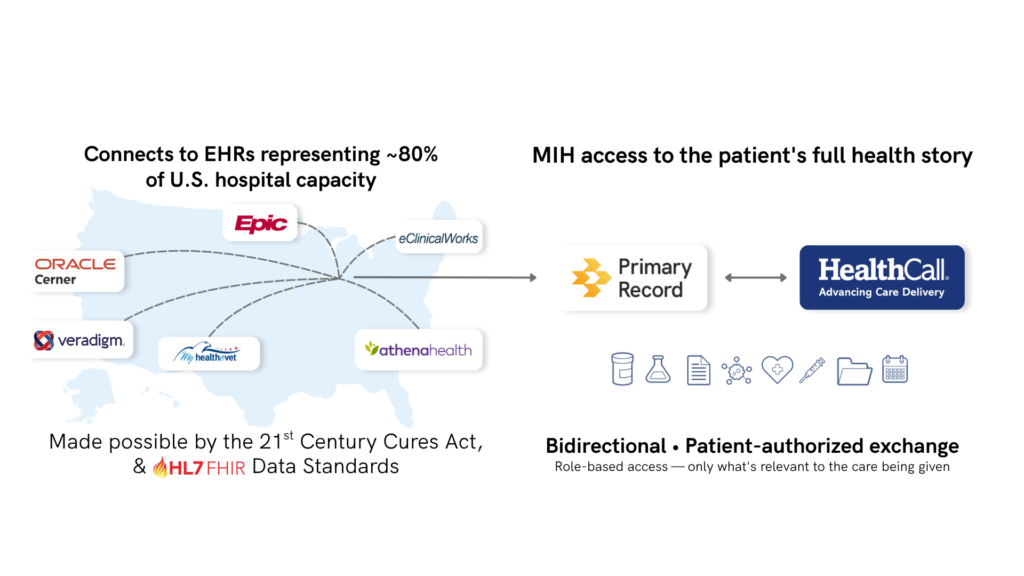
Another wrinkle is easy to miss on paper: in a number of states, the people on the ground, like EMS and mobile integrated health (MIH) teams, aren’t legally recognized as a “treating provider”. That matters because “treatment” is one of only two purposes of use that guarantees a national network response. When a paramedic doesn’t qualify as treating, the pathway that actually works is patient-directed consent: the paramedic asking the person in front of them, in the home, for permission, not an institutional data-sharing agreement negotiated months in advance. A rural MIH program running through a state contract might see only 100-150 patients a year. That’s a tiny volume by network standards, but it’s exactly the kind of real-world test that reveals whether a “connection” helps a workflow.
→ Coming Soon: The Community Paramedic Test
The short version: the question isn’t which network gets funded. It’s whether the connection collapses three logins into one for the person actually standing in front of the patient.
Give Vendors a Choice
The instinct to require every RHTP-funded vendor to plug directly into the state HIE is understandable. It’s the relationship states and the hospitals within them often already trust. But treating the HIE as the only front door often leaves out key community-based teams that’ve historically been priced out of connecting or had no provider sponsor to vouch for them.
A more cost-effective approach evaluates the outcome, not the pathway, and gives each vendor room to connect the way that’s actually efficient for what they do, whether that’s an existing QHIN connection, the state HIE, a CMS-aligned network reached through identity-verified patient access, or patient-directed access under the Cures Act. We will go deep on all four paths, including the ones most states overlook, in a dedicated post.
That’s not automatically a problem, but it does mean vendors a state needs to connect as part of its RHTP plan often face a choice: pay to connect to a state HIE, or pay to connect to a QHIN directly, especially if they operate across multiple states and a single state HIE relationship won’t cover them. Some solve this through patient-directed access instead, particularly when their own workforce, like a community paramedic, doesn’t qualify under the “treatment” purpose of use that would otherwise guarantee a network response. States shouldn’t assume the HIE is the only front door. The more useful question is what a vendor’s actual pathway is, and what it costs them to use it. Keeping that cost low is what makes the whole network more likely to survive past year five.
→ Coming Soon: Give Vendors a Choice of QHIN, HIE, or Patient-Directed Access
Where This Becomes Real: The Care Transition
Architecture is easy to discuss in the abstract. It stops being abstract at 3 a.m., when a patient with a documented cardiac history walks into a rural ER and none of that history comes back. Not because it doesn’t exist, but because of where it lives, which governance rules apply, and whether those rules let the ER physician see it in that moment, even with the patient standing right there, willing to consent.
→ Coming Soon: Where Care Breaks at 3 A.M. A Story Every State Should Know
That story is also where patient medical record ownership stops being a philosophical talking point and becomes the practical reason states don’t have to solve “which network” perfectly before they can move. Since 2016, the Cures Act has required every certified EHR vendor to expose a patient access API, a federal path to a complete record that doesn’t depend on which QHIN or HIE the underlying system belongs to, with an enforcement penalty called information blocking.
→ Coming Soon: Patient Medical Record Ownership. The Layer That Makes Vendor Choice Work
The Difference Between Data You Have and Data You Use
Watch for a specific pattern, because it’s the fastest way to build infrastructure that can’t sustain itself once RHTP funding ends: a vendor whose business model is collecting data, not moving it to follow the rural patient. A repository is a recurring bill someone keeps paying to keep the lights on. A pipe is an investment that keeps generating value for every organization on either end of it, long after the grant runs out.
The tell isn’t whether a vendor can point to HIE or QHIN participation. Plenty can, on paper, while providers on the ground still describe a one-way street. The real test: can you name the clinician, paramedic, or care team that pulls the data back out at the point of care, and would they notice if it stopped flowing tomorrow?
→ Coming Soon: Repository or Pipe? How to Spot a Vendor Who Won’t Survive Past the Grant
Five Questions to Ask As You Fund the Needed Integrations
This is the part worth printing out and bringing into your next vendor meeting.
- Which QHIN are you on, and which QHIN is our state HIE on? If it’s the same one or two that reliably exchange with each other — a new direct integration may be a redundant build. If the vendor can’t answer cleanly, that’s information too.
- Who, by name or role, pulls this data back out at the point of care — and would they notice tomorrow if it stopped? If the honest answer is “no one in particular, it’s just available,” you’re funding a repository, not a pipe.
- Does the data land inside a tool the provider is already using, or does it create a new portal to log into? Every new login is friction a rural provider has to absorb.
- Can a patient or authorized caregiver direct this data to flow, independent of whether the two institutions trust each other? If access depends entirely on a bilateral data-use agreement, ask how long that realistically takes to negotiate — and what happens to rural patients in the meantime.
- What does this relationship cost the state in year six, after the grant is gone? A repository model usually means an ongoing bill with no independent source of value. A pipe model keeps generating value whether or not the state is still writing a check.
None of these questions require a vendor to be lying to give you an unsatisfying answer. Plenty of well-intentioned organizations will have a real answer to two or three and a genuine gap on the rest. That gap is exactly what RHTP dollars should be aimed at closing, not another version of a connection that already technically exists somewhere else.
New to the Vocabulary?
If terms like QHIN, TEFCA, HIE, and NEMSIS are new, or you just want a clean reference to send a colleague, we are putting together a plain-language glossary covering exactly what you need to know to have these conversations with vendors.
→ Coming Soon: RHTP Interoperability 101
The Measure That Actually Matters
It’s worth naming the thing all of this is really in service of, because it’s easy to lose sight of under a grant deadline: success was never going to be measured by how much data moved or how many organizations connected to the HIE. It’s whether rural residents end up with fewer avoidable ER visits, safer care transitions, more consistent chronic disease management, and outcomes that match what patients themselves said mattered. Those are the same outcomes CMS will be asking states to report on so a pipe that doesn’t change what happens to that population isn’t infrastructure. It’s future overhead.
States were never going to become health data architects, and they don’t need to become one to get this right. What they can do is ask the hard questions, hold vendors accountable for building the bridges healthcare institutions have too often avoided, and make sure the ecosystem RHTP dollars fund actually serves the people delivering patient care, not just the organizations sitting on the data.