
If you’ve ever struggled to access lab results…
If you’ve waited for a fax so an evaluation could move forward…
If you’ve spent hours copying and emailing health history between systems…
Then you’re exactly who the federal government wants to hear from right now.
👉🏽 Already know what you want to comment? Click here to learn how to submit your comment to CMS.
What’s Happening?
The Centers for Medicare & Medicaid Services (CMS) recently issued a Request for Information (RFI) on how to improve the digital health technology ecosystem for Medicare beneficiaries and their caregivers. According to CMS:
“Our vision is that individuals, including caregivers, can use technology to easily access, understand, and move their health data when and where it matters most.”
This is your chance to tell them what’s working, what’s broken, and what needs to change.
But comments are only open for a short time, and most people on the front lines of care don’t even know this is happening.
Why It Matters to Comment on the RFI
CMS is gathering public feedback to shape future federal policy, funding, and technology standards. They want to understand:
- What tools families, caregivers, and providers actually need
- What’s creating friction in digital health today
- Where policies are blocking access, usability, and innovation
These insights will inform future rules and national infrastructure, rules that could finally reduce the burden on caregivers, increase data access for families, and support the coordination that patients need to stay safe and informed.
What You Can Do
1. Submit a Comment
You don’t need to be a policy expert. You just need to share what you’ve lived through and what would’ve helped.
You can submit anonymously or with your name. Every voice matters.
2. Reflect on Any of the 177 Questions
CMS included 177 questions across different audiences: families, providers, payers, and technologists. Here are just a handful we believe are especially powerful:
- What features are most important to make digital health products easy to use for Medicare beneficiaries and caregivers?
- Do you have easy access to your own and all your loved ones’ health info in one place?
- If you had a personal assistant to support your health, what would you ask it to help with?
- How can we encourage patients and caregivers to report information blocking?
- How could a national FHIR endpoint directory improve access for patients and providers?
- What strategies help providers make timely, high-quality data available for interoperability?
- What improvements are needed so patient apps can streamline intake and scheduling?
- How can we better encourage open, standards-based APIs over proprietary ones?
- How important is it that all data in an EHR system be accessible, no matter the format?
- Are you aware of apps that help Medicare beneficiaries and their caregivers?
- What health data is valuable but hard to access for patients, caregivers, or app developers?
- In what contexts would it be most valuable to access all health info in one place?
- What are the most valuable operational use cases for patients and caregivers?
Have you felt this kind of frustration firsthand?
Then your voice belongs in this conversation.
How We’re Showing Up
Primary Record was built by people who’ve been there as nurses, doctors, and caregivers; we created the tool we wish we had!
From the beginning, we’ve known that families managing complex diagnoses are the most impacted. That’s why we’ve gone where they turn for support, whether facing a new diagnosis like dementia, cancer, or a rare disease; suddenly depending on a transplant to survive; or navigating long-term care decisions with siblings. We built Primary Record to be one trustworthy place to make sense of it all.
That’s why we’re using our platform to:
- Elevate real stories from caregivers and clinicians
- Break down the RFI into human terms
- Help more people speak up before the June 16, 2025, deadline
If you’ve ever said, “There has to be a better way,” this is the moment to say it out loud.
How to Submit a Public Comment
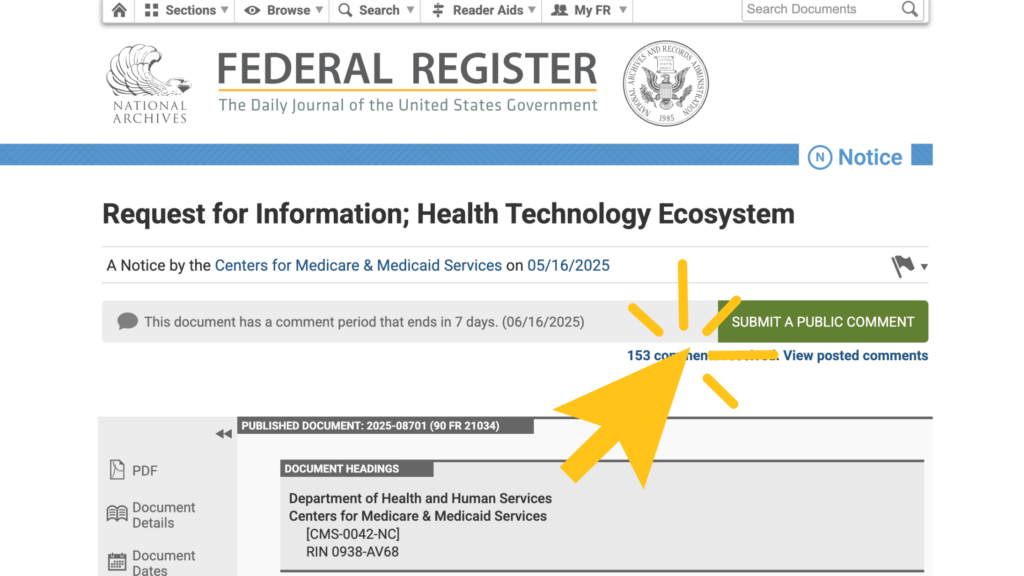
- Go to the RFI: https://www.federalregister.gov/documents/2025/05/16/2025-08701/request-for-information-health-technology-ecosystem
- Click “Submit a Public Comment“
- Complete the electronic form with your comment or upload a file where you have written out your comment.
- Enter your email and identify as an individual, an organization, or anonymous.
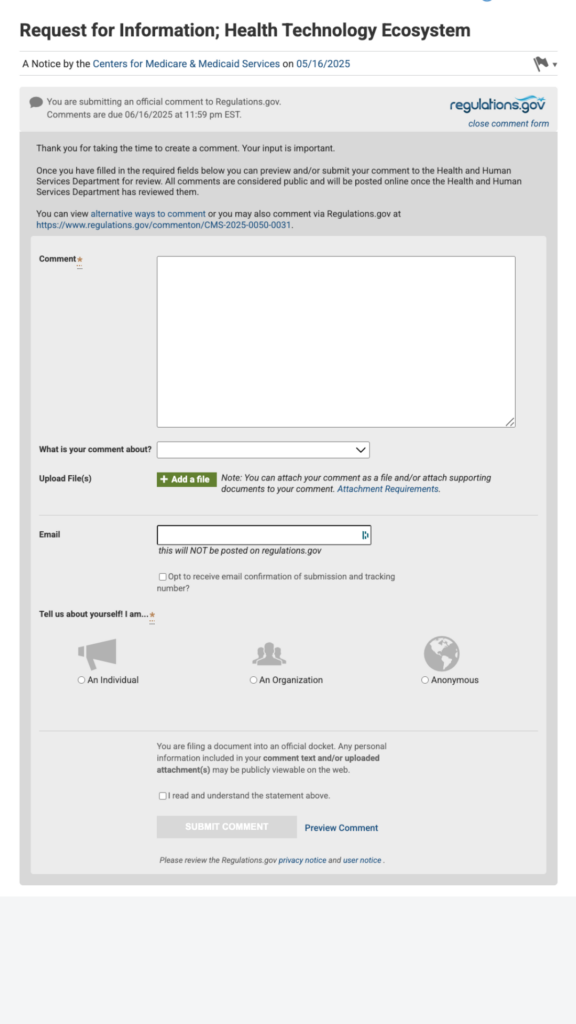
Deadline: June 16, 2025 at 11:59 PM ET
Need help? Contact us
Let’s build a healthcare system that works for the people doing the real work. Starting with us.