
Electronic health record (EHR) transitions are among the most complex changes a healthcare system can undergo. And while they’re meant to improve care, these transitions often lead to unexpected gaps: records that don’t transfer, patient histories that vanish, and portal access that breaks down just when families need it most. With the White House recently announcing new efforts to prioritize patient-facing access and data ownership, it’s clear that this is no longer just a technical challenge…it’s a national priority.
For patients and families, these changes are often invisible until suddenly, the portal they count on is unavailable.
For healthcare teams, an EHR switch can take months—or even years—of preparation, including adjusting workflows, prioritizing which patient records to transfer, and responding to patients who are confused or frustrated when key information seems to be missing.
At Primary Record, we’ve spent the past five years helping families manage their health records across dozens of patient portals. Again and again, we’ve seen the same pattern: a sudden gap in the timeline, where years of records seem to vanish without explanation. When we investigate, we often find the same root cause: an EHR vendor switch. Records weren’t transferred, archived access was never restored, and no one told the family what was missing.
This article is for anyone navigating or preparing for an EHR transition, especially frontline clinicians, care managers, and families who rely on timely, accurate health information.
Across the country, patients are encountering similar moments of confusion and loss when their health systems make the switch to new EHR platforms.
When Meg Devoe arrived at a follow-up appointment after her provider transitioned, she was shocked to discover that none of her previous records had carried over:
“Imagine going to a follow-up appointment, only to find your entire medical history… gone. That’s what happened to me after my healthcare provider’s org switched to Epic from Cerner. Years of my health data, just wiped away. I am hoping I can get it back via paper. Sigh… This should be fun.
It made me think, ‘why don’t we, the patients, own our health records?’ Our data should be in our hands, not lost in a system change, owned by an insurance company or hospital. I want my data…
Now picture this: a patient-owned record that’s always with you. And even better, a family health record that keeps your loved ones’ medical history safe and accessible, all in one place.”
Meg’s story echoes what we’ve heard from caregivers, nurses, and health information professionals alike: this isn’t just about a missing note. It’s about lost trust, broken continuity, and missed opportunities to deliver safer, more informed care.
What Really Happens During an EHR Migration
Whether your hospital is switching to Epic, Oracle, Athena, or another system, here are a few insights from healthIT and clinical experts that families and care teams don’t always know:
- Not all records are moved. Systems often migrate only the records of “active” patients, defined by the hospital’s own criteria. One-time ER visits or older imaging may be archived, not transferred.
- Structured data is prioritized. Clinical notes, imaging reports, or PDFs may stay in the old system or be stored in an archive not accessible through the new patient portal.
- Manual re-entry is common. Nurses, medical assistants, and IT staff often have to re-enter key data fields for current patients. This process is labor-intensive, and mistakes or omissions can easily happen.
- Patients may never be told. Unless someone specifically requests their records or logs in to check, they may never know their health history was not transferred. Some states have seven-year retention policies, but families are rarely notified before data gets archived or purged.
- Proxy access can break. Caregivers helping a parent, child, or partner may lose access if the new system requires fresh documentation. Many systems require in-person verification, even for authorized family members.
These aren’t just technical details. They show up in the real world as distress, delays, and difficult conversations.
For Clinical Teams: What Nurses and Care Managers Can Do
Clinical teams are the bridge between families and health systems. Here are some practical steps from experts in the field:
- Preload what matters. If you know a patient is in active care, advocate for their key records, such as imaging, medication lists, and summaries, to be available in the new system or added to shared notes.
- Educate patients early. Let them know a change is happening. Encourage them to download their current records or print important documents ahead of your scheduled go-live date.
- Simplify proxy workflows. Work with Health Information Management or patient access teams to ensure caregivers can re-establish proxy access, especially for older adults, pediatric patients, or out-of-state family members.
- Flag gaps in handoffs. Discrepancies in medication lists, problem histories, or missing encounter notes often show up during transitions of care. When they do, raise concerns early to reduce downstream errors.
For Patients and Families: What You Can Do
- Download your records early. Before the system switches, request a copy of important documents, summaries, and imaging. Some data may not be accessible later.
- Confirm portal and proxy access. Make sure you and your loved ones can log in, share access, and update preferences after the switch.
- Ask questions. If something seems missing, it might be in an archive. Ask the Health Information Management department how to retrieve it.
- Tell your care team. If you can’t find a history of an ER visit, a medication, or a past diagnosis, let your provider know. They may be able to locate it in internal systems that are not visible to you.
Why This Matters
In healthcare, information is care.
When critical data is missing, fragmented, or hidden during a system transition, it can lead to delays, repeated tests, and even harm. It frustrates families. It burdens clinicians. It undermines trust in the system.
These challenges are not just technical. They are deeply human.
Where Primary Record Fits In
At Primary Record, we help families build a continuous, patient-centered health history that travels with them across systems, providers, and time.
We’re not here to replace a hospital’s EMR or patient portal. We’re here to extend it by putting essential health information in the hands of the families trusted to support patients through every care setting, from home to school to senior living.
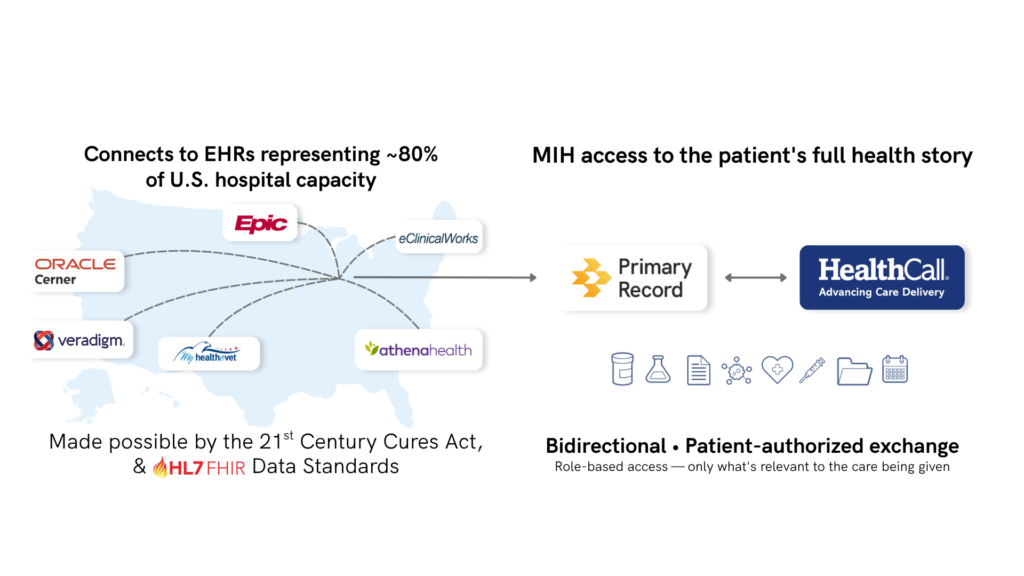
Our platform connects to the systems you already use, enabling patients and their proxies to download a high-level summary and preserve a longitudinal record that may not be easily accessible during or after an EHR transition.
If your organization is preparing for a system change, we’d love to support you. Because the patient story should never be lost in migration…it should be protected, preserved, and portable.