

At the intersection of care coordination and community health, the most important question isn’t always the most technical one. Sometimes it’s the one a colleague asks over a Friday afternoon virtual call that you can’t stop thinking about.
Mandy Williams, Vice President of Programs at LifeStream, an innovative Area Agency on Aging (AAA) serving rural Indiana, asked me one of those questions. We were talking about care transitions, about what happens to patients after discharge, about all the things that fall apart between the hospital door and the kitchen table. And she said it plainly: Why do we build medical care pathways but not social care pathways?
That question landed differently after I’d been reading Christina Rodriguez’s analysis of why food as medicine keeps failing. Her argument is that the problem isn’t that clinicians don’t care about nutrition, but that food interventions aren’t embedded in the prescription workflow. They sit outside the system, waiting to be referred to, leaving the community-based organization running point without any sustainable funding attached to their role.
Two different conversations. The same gap. It’s time we answer Mandy’s question.
Medicine Already Knows How to Do This
Take heart failure. It’s one of the most resource-intensive conditions in the country, and we’ve spent decades building the medical response to it.
We know who the patient needs to see and when. We know the drugs, the titration schedule, the testing intervals. We know to watch weight daily, monitor fluid status, restrict sodium, educate on red flags. We know what happens at every stage, from diagnosis to decompensation to discharge, and we’ve built clinical pathways that create structured accountability at each point.
But here’s what I also know after years at the bedside as a nurse: the clinical pathway doesn’t reach the patient’s zip code.
I’ve watched patients struggle not because they didn’t understand their diagnosis, but because they couldn’t afford the low-sodium food, couldn’t make the follow-up appointment without a ride, couldn’t remember which pill was which after a confusing discharge, or lived alone without anyone to notice their ankles swelling before it became a 911 call.
The clinical pathway is solid, but it stops at the hospital door.
What a Community Care Pathway Could Look Like
Imagine we built the social equivalent, a community care pathway, with the same intentionality we bring to the medical one.
For our heart failure patient going home, that pathway might look like this:
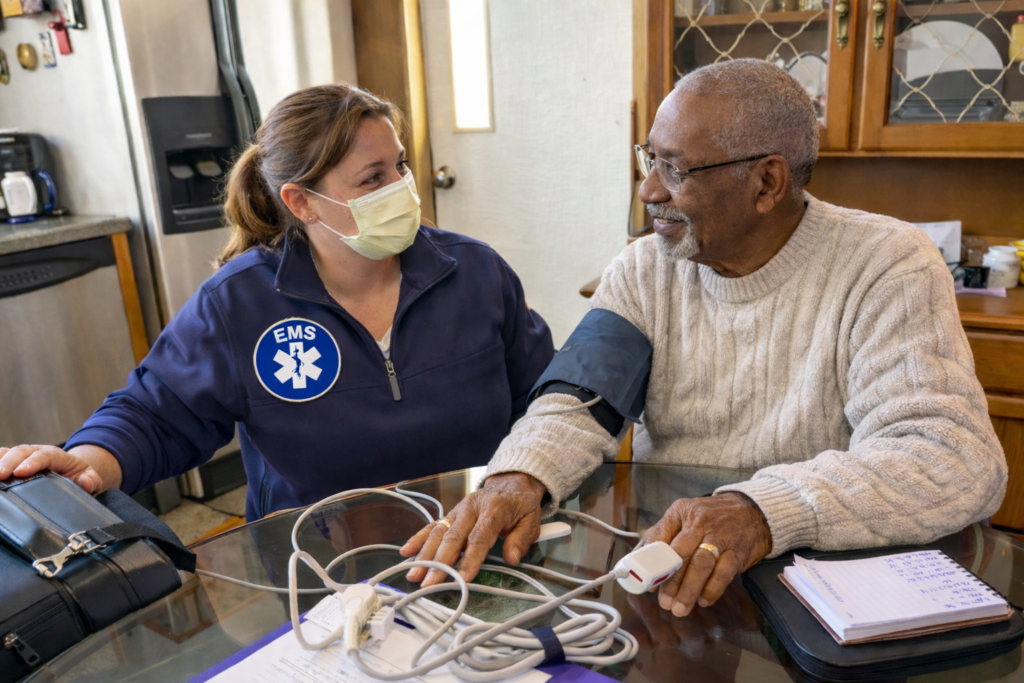
The community paramedic is dispatched within 48 hours of discharge. Not for a clinical emergency, but to sit at the kitchen table, open the medicine cabinet, and reconcile the discharge paperwork against what’s actually there. They catch the duplicates, the confusing brand-generic swaps, and the medication the patient never filled. This is the real home med rec.
When the first transportation barrier surfaces, an alert goes to the area agency on aging from the community paramedic, not after the third 911 call, but when the first transportation barrier surfaces. Because if an older adult in rural Indiana can’t make it to cardiology, we should know before they decompensate, not after.
In scheduling transportation, they then assign a community health worker (CHW) who can provide teach-back education, not once at discharge, but repeatedly, at whatever pace the patient needs, until confidence is real. Managing heart failure isn’t a pamphlet. It’s a skill. And building that skill takes a relationship, not just a one-time referral.
Each of these community nodes is doing critical work. None of them are in the same system. None of them are reliably funded for it. And right now, there’s no structure defining who’s responsible for what, how handoffs happen, or how we know when a gap has been left unfilled.
We just haven’t designed healthcare infrastructure from a multidisciplinary perspective through the patient’s experience, and when we do so for those at highest risk, the pathway becomes obvious.
The Rural Dimension Makes This Urgent
In rural communities, the distance between these community nodes isn’t just geographic, it’s systemic. There are fewer providers, fewer community-based organizations (CBOs), longer distances, and far less infrastructure connecting the clinical world to the social one. The area agency on aging may be the only entity serving multiple counties. The community paramedic program may not exist yet. The CHW may be funded by a grant that expires in six months.
And yet, these communities often have something urban systems lack: proximity, relationships, and local knowledge. A rural AAA knows the resources that exist. A community paramedic in a small county knows which neighborhoods have no grocery access. A CHW may have grown up down the road from the patients she serves.
The question isn’t whether rural communities have what it takes to build these pathways. The question is whether we’re willing to fund the infrastructure needed to make them sustainable.
A New Data Governance Model: Patient as Authorizing Agent
That requires two things we haven’t built yet.
The first is a shared record that the patient can direct, something that lets them quickly personalize where they are in their community care pathway, share it across the community nodes supporting them, and ensure the CHW, the paramedic, and the AAA are all oriented to the same person, not to separate siloed encounters. This isn’t just an interoperability problem. It’s a consent and trust problem. The patient has to be the one directing their own information.
Because here’s where the system fights back.
Even as federal interoperability law gives patients an increasing right to their own health data, state-level Medicaid policies and program rules are creating friction in the opposite direction. The argument, well-intentioned on its face, goes something like this: “once data leaves our system and enters the patient’s hands, we can’t control where it goes next. We don’t know who sees it. We can’t guarantee it won’t be misused.“
That’s a real legal concern. It’s also being used, in practice, to block the very coordination it claims to protect.
What’s missing isn’t a better privacy law. What’s missing is a new model of data governance built around the patient as the authorizing agent, not the institution. When a patient gives informed, specific, revocable consent for their information to flow to the CHW supporting their discharge, the community paramedic doing their home med rec, and the AAA arranging their transportation, that consent is the protection. The chain of accountability follows the patient’s direction, not the organization’s risk tolerance.
We are asking patients to navigate a care system that refuses to share information on their behalf because it can’t control what happens next. And then we wonder why they fall through the gaps.
The second is data that tells the story of value. Right now, CBOs carry the load of social care without the documentation infrastructure to show funders what that load actually does. When the AAA connects a patient to transportation, and that patient makes their cardiology appointment and avoids a hospitalization, that’s a HUGE value. We need shared data models that make that chain visible, so funders aren’t just investing in outputs but in outcomes.
These two things are connected. The same patient-directed record that enables coordination also generates the longitudinal data that proves the community care pathway works. When the patient is the thread running through every community node, authorizing the share, personalizing the pathway, directing the handoffs, the documentation of what happened isn’t a separate administrative burden. It’s a byproduct of care done right.
A Question Worth Sitting With
If you are currently working on redesigning rural health from CMS Rural Health Transformation Program, whether you’re in a hospital, an AAA, a public health department, a community paramedicine program, or a health plan, I want to leave you with something concrete.
Pick one story you see every week. The patient who keeps coming back to the ER. The older adult who missed four follow-up appointments. The heart failure readmission that happened three weeks after discharge.
Now ask: If we were going to build a community care pathway for this person, who is responsible for what? How do we monitor capacity and handoffs? How do we share the load of assessments and tasks across the organizations touching this life?
The Harder Question: How Do We Pay for It?
But don’t stop there. Ask the harder question underneath it: How do we pay for it in a way that doesn’t disappear when the grant runs out?
This is where rural health hits a wall that good intentions alone can’t move. Mobile integrated health programs have demonstrated real impact, reduced ER visits, better chronic disease management, fewer readmissions. The evidence is there. What isn’t there, in most rural communities, is the risk-based contract that makes the investment sustainable. Accountable Care Organizations (ACOs) and Medicare Advantage plans fund MIH because they’re responsible for the total cost of care, and an avoided hospitalization saves them money. But that math only works when there are enough attributed lives to make the contract viable, and many rural counties don’t clear that threshold on their own.
That’s the chicken-and-egg problem of rural value-based care. And solving it requires a different kind of creativity.
In Indiana, that conversation is starting to shift toward regional thinking, not just one county trying to demonstrate savings, but a coalition of rural communities pooling attributed populations, sharing MIH infrastructure, and making the value visible at a scale that a payer can actually contract against. The alternative, building patchwork programs that only reach the highest-cost utilizers in a single county, doesn’t fix anything. It moves the problem. When one county stabilizes its frequent flyers, the next county’s numbers get worse because the underlying care model for heart failure patients hasn’t changed. You don’t solve whack-a-mole by getting faster at the hammer.
What rural health needs isn’t more pilots. It’s a financing architecture that treats the community care pathway as infrastructure, the way we treat roads and broadband, and funds it accordingly. That means getting creative about regional ACO formation, community benefit investment from health systems with Hospital Readmission Reduction Program (HRRP) exposure, Medicaid managed care contracts that recognize avoided costs, and yes, grant funding used strategically to prove the model before the value-based contract is in place, not as a permanent substitute for one.
We’ve spent decades perfecting the clinical pathway. We know how to define accountability, sequence interventions, and track outcomes inside the hospital.
Now it’s time to build the one that starts when the patient goes home.
Because healthcare and human both start with H, that is not a coincidence.
Let’s Build This Together
This isn’t a theoretical problem. It’s the one showing up in your ER, your discharge planning meetings, your AAA intake calls, and your MIH program logs right now.
At Primary Record, we work with those integrated health and social care teams to design the coordination infrastructure that makes community care pathways real, not just on paper, but in practice. That means shared data models, consent-driven information exchange, and the outcome documentation that helps you tell your funders the story of value they need to hear.
If you’re working on this problem in rural Indiana or anywhere else, if you’re the one asking Mandy’s question, we’d like to help.