
Why giving members their data isn’t the finish line…it’s the starting point.
For the past few years, health plans have invested millions to comply with CMS interoperability rules. Claims data pipelines. FHIR servers. OAuth log-ins. Patient Access APIs.
But here’s the uncomfortable truth:
Most plans don’t actually know what happens after the data leaves their system.
Did the member see it?
Did it help them?
Did it help their caregiver?
Did it reduce confusion at the next appointment?
Did it prevent an out-of-network visit?
Did it catch a missed follow-up?
Did it stop an avoidable ED visit?
No one is measuring this. Meanwhile, every family is living it.
And this is where the real ROI sits, not in the infrastructure, but in the last mile of interoperability.
The Real Interoperability Gap Isn’t Payer-to-Provider. It’s System-to-Kitchen Table.
Health plans can’t see it, but here’s what’s happening in the real world.
When a member faces a new diagnosis, surgery, fall, or hospital readmission, the person who does most of the coordination work isn’t the health plan.
It’s the daughter.
The spouse.
The adult child.
The neighbor.
The pastor.
The home care aide.
The community care manager.
The coach.
The parent of the teen.
The caregiver of the dementia patient.
The aunt managing a nephew’s ADHD meds.
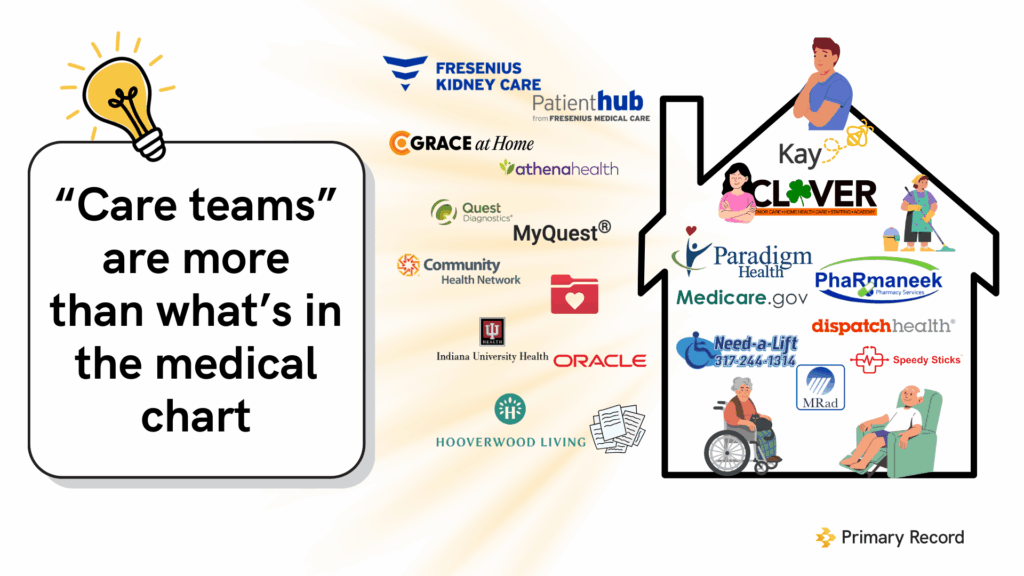
The actual care team is rarely the one listed in a medical record.
For decades, the healthcare system has treated these people as invisible. That’s the last-mile gap. Patient Access APIs, if used intentionally, can finally close it.
What Members Actually Receive Through the Patient Access API
This is the part that gets buried in regulatory language. Here’s what members can see when they use an app:
- Their claims and encounter history
- Their clinical problems, labs, vitals, meds (as the plan has received them)
- Coverage and formulary details
- By 2027: Prior authorization requests + decisions in near real-time
This is powerful.
More importantly, this is every major life event, diagnosis, referral, bill, and medication, finally, in one place, the family can understand and act on. But health plans rarely follow their own instructions to see what it is like for a daughter at 4:32am trying to make sense of her parents’ benefits and medical history.
If they did, they’d see the ROI immediately.
The 3 Big ROI Areas Health Plans Are Overlooking
CMS built the infrastructure.
Health plans funded it.
But ultimately, outcomes depend on what families do with the data.
ROI #1: Care Gaps Close When the Real Care Team Can See What’s Going On
The Patient Access API helps a caregiver answer questions in real time that no plan call center ever could:
- “Did she get the follow-up ultrasound?”
- “Has he filled his blood thinner?”
- “Did anyone ever read that pathology report?”
- “Was that ER visit ever followed up on?”
When caregivers can see claims + labs + visit history in one place, they catch the early warning signs.
This is how you prevent:
- avoidable ED visits
- missed screenings
- medication errors
- unnecessary readmissions
This is measurable, real-world savings, but only if plans look beyond raw utilization metrics and track actual behavioral outcomes.
ROI #2: Trust and Retention Improve When Members Feel Supported Between Appointments
Every plan wants higher CAHPS.
They also want better Stars.
And ultimately, every plan wants better retention.
Here’s the simplest way to get all three: Help the member and their family understand what’s going on.
When a member opens an app and sees:
- their benefits
- their claims
- their labs
- their prior auth status
- their meds
…everything gets easier.
Confusion goes down.
Repeat calls go down.
Anxiety goes down.
The plan stops being a black box.
Plans spend millions on member engagement, but the most effective engagement strategy may be the one they were required to build: the Patient Access API.
ROI #3: The Data Becomes Reusable at the Moments of Care (and That Changes Outcomes Entirely)
Here’s a truth that plans rarely acknowledge:
Members don’t make healthcare decisions while reading a PDF EOB.
They make decisions in real-time moments of care:
- at urgent care
- at a specialist consult
- during a telehealth appointment
- at a walk-in clinic
- while talking to a care manager
- during a PT evaluation
- while reviewing meds at the kitchen table
- while calling grandma’s cardiologist
- while coordinating a discharge from the hospital
- while arguing with the SNF about missing paperwork
The ROI shows up when the data can be shared by the person who needs it.
Not as a fax.
Not as a portal login.
Not as a screenshot.
But as a clean, organized record, they can share from the phone in their hand.
That’s the last mile. That’s the real-world interoperability that changes outcomes.
Why Health Plans Miss This: They Can’t See the Community Layer
A plan may know the PCP, cardiologist, and endocrinologist.
However, they’ll never have visibility into…
- the daughter filling the pill box every week
- the home care aide noticing early dementia symptoms
- the church volunteer driving to appointments
- the care manager coordinating across systems
- the school nurse monitoring chronic conditions
- the community paramedic reviewing post-discharge instructions
This invisible ecosystem is where outcomes are actually won or lost.
Patient Access APIs help data reach this layer for the first time, but only if the plan treats it as more than a compliance checkbox.
How Primary Record Helps Plans Realize the ROI of Interoperability
Primary Record was built for one reason:
To make sure the data securely reaches the people doing the caregiving, so they can verify and use it with the people helping them.
We call this the Last Mile of Interoperability.
The pipes (FHIR, APIs, compliance) matter. But the outcome depends on whether a caregiver can:
- see the diagnosis history
- understand the timeline
- share a lab result
- prepare for an appointment
- coordinate across providers
- advocate confidently
- prevent the next crisis
That’s where the return is.
That’s where plans gain real value.
That’s where families gain real peace of mind.
The Opportunity for Health Plans in 2026 and Beyond
You’ve already made the investment.
You already built the APIs.
You already met the CMS requirements.
Therefore, the ROI questions become:
- Are members (and caregivers) actually using the data?
- Are they stopping avoidable ED visits?
- Are they closing care gaps faster?
- Are they making more informed decisions?
- Are they less confused at transitions of care?
- Are you retaining them longer?
- Are they reporting better experiences?
If your answer is “we’re not sure,” you’re not alone…
In fact, almost no one is measuring this.
But you could.
And if you do, you will lead.
The next era of plan performance will be defined not by infrastructure, but by whether members, and the people who care for them, can finally use their own data to stay safe, informed, and connected.
Patient Access APIs opened the door.
Primary Record delivers the last mile. Learn more from the team that has been obsessed with helping patients and caregivers use their health data for better care.