
During my internship at Primary Record, I finally had the chance to put words to something I’ve quietly carried for years: what it feels like to navigate the mental health system with no continuity. For as long as I can remember, every new therapist, counselor, or psychiatrist meant starting over, retelling the hardest parts of my life from scratch, hoping they could piece together a story the system never seemed able to hold for me.
Why So Many Start Over in the Mental & Behavioral Health System
As a sixth grader, I had to share the most vulnerable parts of my life with two different adults in the same school year. As a young adult, switching psychiatrists meant reliving my entire history, every medication I’d tried, every side effect, every dark moment I thought I’d already explained.
“It felt like my story didn’t exist anywhere except in my own memory.
The system never remembered for me.”
What surprised me during my internship was learning why the system feels the way it does. All mental and behavioral health information is protected under HIPAA, but Substance Use Disorder (SUD) records carry an additional layer of protection under a stricter federal law called 42 CFR Part 2.
Part 2 used to require specific, written consent almost every time SUD-related information moved. But as I learned during my internship, the rules were recently updated. Under the 2024 Final Rule, patients will soon be able to give one consent that allows their SUD information to be shared for treatment, payment, and healthcare operations, similar to HIPAA. That change becomes effective in 2025, with full compliance required by 2026.
It’s a major step forward, but it doesn’t erase the decades where SUD data lived in its own locked box. That history shaped the culture of behavioral health. Even information that can be shared under HIPAA is often treated as if it is too sensitive to move. The result is a system where providers hesitate, systems aggressively segment data, and patients like me end up carrying our entire story from one office to the next.
So even with the new law, the lived experience hasn’t changed yet: when I show up at a new therapist or psychiatrist, they rarely have the information they need to understand where I’ve already been. I still start over. I still re-explain every medication, every reaction, every chapter of my mental health history.
In an era where health information can flow across hospitals in seconds, this gap in behavioral health is not just an inconvenience. It’s a crisis of continuity, one that affects families, therapists, psychiatrists, teachers, and anyone trying to care for someone navigating a mental health condition.
And unlike other parts of healthcare, the reasons aren’t merely technical. They are rooted in law, culture, stigma, privacy, workflow, and the long-standing belief that mental health exists in a sealed room rather than as part of a person’s whole care journey.
This is the story of what’s breaking, and what we can finally begin to fix.
The Problem: Mental Health Data Lives in Silos Built to Protect, Not to Coordinate
Jean Ross, RN, interviewed licensed mental health counselor Lacey Seger, a private-practice clinician, who summed it up in one powerful statement:
“In my field, clinicians are trained to guard patient information with extreme care; we share nothing unless the patient themselves authorizes it, because their trust depends on it.”
That default is rooted in how the field was built. Behavioral health clinicians work under some of the highest privacy standards in healthcare, including 42 CFR Part 2 for SUD, specifically to safeguard patients from stigma, discrimination, and legal risk.
These laws matter. They save lives by protecting people from exposure. But the unintended consequence is a workflow many patients recognize:
- Each new psychiatrist starts from scratch.
- Therapists rely on memory or phone tag to coordinate care.
- Families carry the burden of piecing together medication history.
- Crisis events are followed by silence, not shared discharge plans.
And while therapists document clinical impressions and progress notes, the content of those notes is often too narrative, too contextual, or too sensitive to be handed off to other providers without careful consideration.
“Some clients aren’t in a stable place,” Seger explained. “Reading raw notes could be more distressing than helpful.”
Privacy is essential. But privacy without coordination creates its own kind of harm.
The Story Beneath the Story: What Happens When Records Don’t Follow the Person
During my research, one theme emerged again and again: behavioral health depends on relationships, not records… yet records still matter.
Therapists often rely on nuanced, narrative documentation, just enough to track clinical direction, but not designed for cross-provider interpretation. Psychiatrists depend heavily on short visits and patient self-report, unaware of the day-to-day mood shifts a therapist may observe. School counselors and family members notice patterns that never make it into a portal or discharge summary.
And during transitions, everything falls apart:
- A teen’s therapist and school counselor may work toward different goals with no shared view.
- A spouse caring for someone in a manic or psychotic episode may be completely shut out without explicit permission.
- A parent loses access to their child’s medical portal at age 12, even while being asked to manage their care.
- A new therapist has no map to understand what has already been tried, accomplished, or abandoned.
None of these breakdowns happen because families or clinicians don’t care; they happen because the system isn’t built to support them. Lacey explained it best:
The root of the problem is a systemic failure of access during a crisis. When someone enters a mental health emergency and loses the ability to give consent, loved ones are suddenly cut off. If a client is admitted and cannot communicate, the system’s default response is to leave partners and families completely in the dark, unable to locate them, understand what is happening, or offer support. Legal tools like a Power of Attorney or an advance directive can help, but they are rarely in place during an unfolding crisis. The default should not be silence; it should be a pathway that recognizes and strengthens the person’s existing care network.
The irony is that the very laws designed to protect privacy often end up isolating clients at the moment they need connection the most. When someone cannot grant permission, the system effectively removes their entire support structure. That is not the kind of patient-centered care clinicians intend, nor the kind of relational support clients rely on.
The Insight: There Are Parts of the Mental Health Record That Can and Should Be Interoperable
Here’s the turning point.
Not everything in a mental health record should move. Psychotherapy notes, personal reflections, narrative observations, and sensitive substance use disorder details require protection.
But there are specific components that clinicians, patients, caregivers, and behavioral health experts universally agree are:
- Safe
- Expected
- Clinically meaningful
- Patient-owned
- And essential for continuity
These components form what we call the care-plan layer of mental health documentation.
They include:
Shared Treatment Goals
Not the therapist’s private notes, just the goals that the therapist and client have already co-created together.
Seger put it best:
“You wouldn’t be surprised by what’s in your treatment goals.
We build them together.”
These goals rarely change, and they anchor the work being done. They’re the connective tissue between therapy, school supports, psychiatry, and daily life.
Medication History + Real-World Response
When medications change hands, from primary care to psychiatry to crisis stabilization, continuity becomes critical.
Patients often cannot reliably recall:
- what they were taking,
- what dose,
- why it was changed,
- or how it affected them.
Therapists often see the day-to-day response that prescribers never get to witness.
This is the exact type of structured data that, if patient-directed and safely segmented, can follow the person.
High-Level Behavioral Observations (Not Raw Notes)
Patterns like sleep disruption, panic attacks, mood elevation, or functional impairment can be summarized without revealing intimate session content. These patterns help the next clinician orient quickly, preventing misdiagnosis or redundant treatment.
Crisis Events + Discharge Plans
A crisis shouldn’t erase the record of what happened.
A patient-approved summary of a hospitalization, reason for admission, key medication changes, safety plan, can prevent a revolving door of repeated crises.
None of these components requires sharing sensitive psychotherapy narratives. All of them improve safety, continuity, and care.
The Solution: Patient-Directed Interoperability for the Parts That Matter Most
At Primary Record, they aren’t trying to crack open therapy notes or override privacy law. I learned they are doing the opposite:
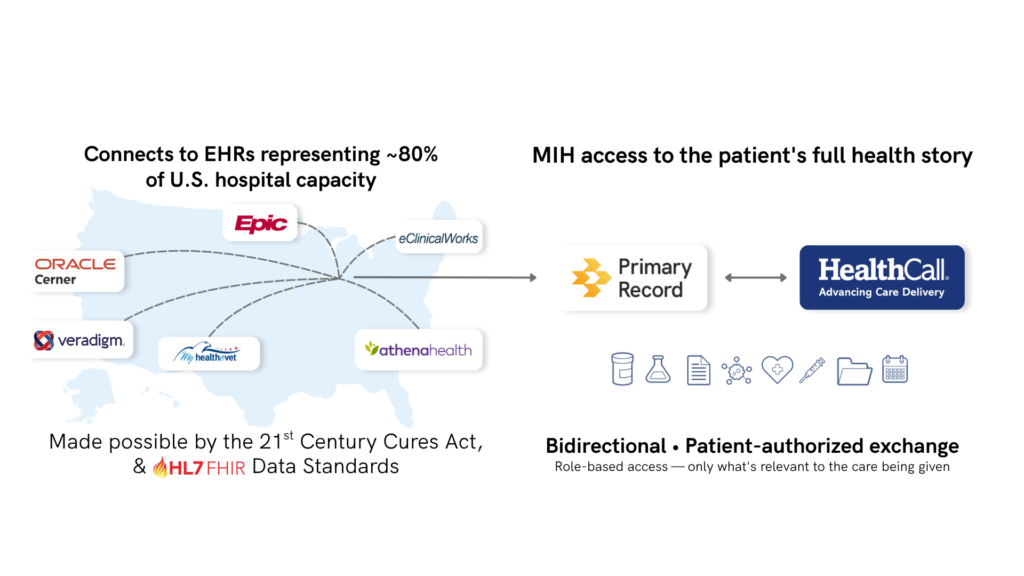
Primary Record could help families capture, organize, and safely share only the parts of behavioral health data that strengthen care coordination without compromising the therapeutic relationship.
Families, teens, caregivers, therapists, and patients can use Primary Record to:
- Store and share treatment goals
- Document medication changes and side effects
- Track mood or behavioral observations over time
- Upload discharge summaries or safety plans
- Invite trusted professionals into the care plan
- Manage consent in a clear, structured, patient-led way
In a future we’re working toward, a person could approve a psychiatrist’s request:
“Your therapist wants to send over your treatment goals. Do you approve?”
One click.
One shared understanding.
One step toward continuity.
This isn’t about opening the private world of therapy; it’s about giving patients agency over the parts of their care that genuinely need to move.
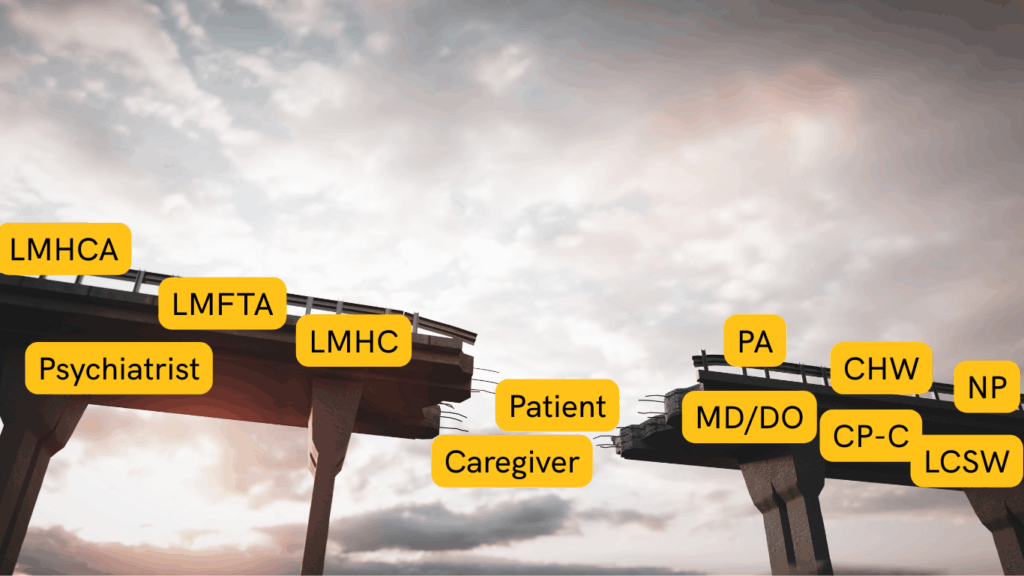
The Bridge We Can Build
My story is the same story lived by millions. Lacey’s clinical reality is echoed in every practice across the country.
Mental health interoperability doesn’t have to be an all-or-nothing proposition. It can be careful, safe, segmented, and patient-directed. And when we focus on the care-plan layer, goals, medications, patterns, and plans, we make space for:
- smoother transitions
- safer medication management
- less retelling
- less crisis
- more continuity
- and fewer families left to navigate alone
The bridge between behavioral health and the rest of healthcare has been broken for a long time. But piece by piece, we can rebuild the parts that matter most.
Not every detail.
Not every note.
Just the information that helps the next person care better.
And that is a bridge worth strengthening.